

Touchpoint provides a window into the discussion of service design, facilitating a forum to debate, share and advance the field and its practices. In addition, it aims at engaging clients to listen in on the discussion, learn about the field, and become involved in the developmentand implementation of service design for their organisations. The three key audiences of the publication are:
- Service design practitioners
- Client organisations including businesses, non-profits, and public sector/government
- Academia
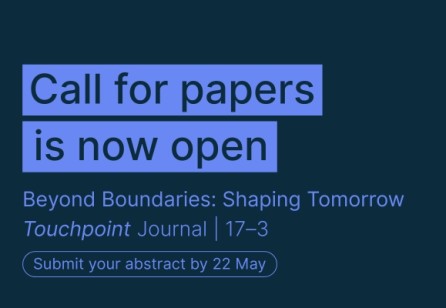
Touchpoint 17-2 Call for Papers: Emerging Service Design
Service design is no longer a nascent discipline; it has matured into a core strategic function within organisations large and small, as well as the public sector. But maturity carries the risk of standardisation and the sedimentation of best practices that can inadvertently stifle the sometimes radical innovation a field needs to grow and push its boundaries.
This upcoming issue of Touchpoint aims to serve as a deliberate intervention, calling us to look beyond the established horizons of our field. By spotlighting 'Emerging Service Design’, we invite a critical dialogue between the fresh, uninhibited provocations of the next generation and the nuanced reflections of seasoned practitioners about where we’re headed. We seek to uncover the ideas, experiments and shifts in perspective that are currently on the periphery but have the potential to redefine the core of our discipline.
Our standard service design toolkit (if there is such a thing!) is being fundamentally challenged by rapid evolution within and outside our discipline, raising an uncomfortable question: are we building on solid foundations, or are we simply repeating familiar patterns with increasing confidence?
This issue of Touchpoint invites contributors to examine that tension directly. We are looking for articles that do one or more of the following:
- Challenge assumptions that our field takes for granted
- Document experiments (successful or not) that point to new directions
- Offer grounded perspectives on how the discipline is actually changing (not just how we wish it would)
The questions we pose below are meant as starting points and provocations. We encourage potential contributors to engage with them critically, and to surprise us.
Reframing our discipline
- What long-established service design tools or deliverables (e.g., the ‘Double Diamond’, journey maps) are currently being challenged, and what is emerging to take their place?
- How is the definition of value shifting from purely user-centric or profit-driven models to those that prioritise things such as ecological health and social equity?
- In the era of ‘designing from within’, how can emerging practitioners maintain a radical, critical edge while operating inside large and complex bureaucracies?
New tools and methods
- How are technologies such as AI, blockchain, robotics or IoT being used not just as components in service delivery, but as active participants in the design process itself
- What new (visual) models and frameworks are being developed to map and design for non-human stakeholders or systems-level impacts?
- How can service design better integrate speculative design and ‘futuring’ to move from solving today's problems to shaping tomorrow's possibilities?
Education and practice
- Does current service design education adequately prepare the next generation of practitioners for the messy, interdisciplinary and sometimes ethically complex reality of modern practice? If not, what can be done to address this?
- What are examples of emerging voices - including those from the Global South or underrepresented communities - which are redefining the cultural and ethical boundaries of our practice, as well as the developing new ways to achieve our goals?
- What does a ‘service designer of the future’ look like? What unique competencies will they need to thrive in a market that continues to rapidly evolve?
- How can we bridge the gap between student-led provocations and the practical constraints of professional service design?
Employment contexts
- As more organisations build in-house service design teams, does the so-called ‘agency model’ still have a unique strategic value, or is it evolving into a highly specialised, niche service?
- How are our job descriptions and titles changing, and what does this mean for a core identity of who we are and what we do?
- How are remote and hybrid work models continuing to impact the collaborative, high-touch nature of service design practice and culture?
Collaboration and impact
- What new forms of interdisciplinary collaboration are emerging at the fringes of the field (e.g., service design meets synthetic biology, climate resilience, behavioral economics, sensory design, autonomous systems design or ethics)?
- How can we measure and demonstrate the value of these emerging approaches when traditional metrics may not yet apply?

Share your thoughts
0 RepliesPlease login to comment