
Touchpoint Vol. 17 No. 3 | Call for papers is now open

We are pleased to announce that the call for papers for Touchpoint Vol. 17 No. 3 is now open.

-SUBMIT YOUR ABSTRACT UNTIL MAy 22ND 2026-

Touchpoint provides a window into the discussion of service design, facilitating a forum to debate, share and advance the field and its practices. In addition, it aims at engaging clients to listen in on the discussion, learn about the field, and become involved in the developmentand implementation of service design for their organisations. The three key audiences of the publication are:

  • Service design practitioners
  • Client organisations including businesses, non-profits, and public sector/government
  • Academia

Touchpoint 17-2 Call for Papers: Emerging Service Design

Across the public and private sectors, organisations are confronting boundaries that are structural, cultural, technological and environmental. These are not boundaries that better ideation alone can dissolve. Overcoming them demands the sustained, collaborative, often painstaking work of turning insight into action, and action into lasting impact.


This upcoming issue of Touchpoint will be published to coincide with the Service Design Global Conference 2026 (SDGC26), held in the Frankfurt RheinMain region, as part of the World Design Capital 2026 programme under the theme ‘Atmospheres for a Better Life’. At the conference, we will look at how solutions are developed, implemented and scaled across organisational, cultural and societal boundaries. And we’d also like to do so in the pages of this issue of our journal.


In contrast to our most recent issue (Vol. 17 No. 2: ‘Emerging Service Design’), the theme of this upcoming issue is not about what service design might one day do. It is about what we are being asked to do right now: help organisations navigate transitions, build the conditions for genuine collaboration, embed responsible technologies and ensure that well-designed solutions endure beyond the pilot phase.


We are looking for articles, case studies and critical perspectives that engage with the following five themes. The questions within each are intended as provocations, rather than prescriptions.


Shaping everyday experiences that matter

Better futures are not abstract; they are experienced in daily interactions with services, systems and environments.

  • How can service design ensure that strategic intent translates meaningfully to the point of delivery, where customers, citizens and employees actually experience it?
  • What does it mean to design for ‘quality of life’, not just ‘quality of service’? How do we measure the difference?
  • How can service design harness emerging technologies like agentic AI or mixed reality to enhance human experiences – without undermining trust, agency, or care?
  • How can service designers work with (rather than around) the operational realities of large organisations: the systems, processes, routines and frictions that shape the experiences they deliver?

Enabling collaboration across sectors and systems

Complex challenges — climate resilience, healthcare access, urban mobility, social inclusion — don’t belong to a single organisation. Yet the conditions that make cross-sector collaboration genuinely effective are rarely designed for.

  • What does it take to build and sustain meaningful partnerships across institutional and cultural boundaries? What is our distinct contribution to that process, as service designers?
  • How can we help organisations move beyond performative collaboration toward shared accountability, shared decision-making and shared ownership of outcomes?
    What are the most significant barriers to cross-sector service innovation, and what examples can be cited of where they were successfully navigated?
  • How can technology be used to support trust, shared understanding, and collective agency across partners – rather than reinforcing power imbalances, silos, or extractive forms of collaboration?

From insight to impact: Making change stick

Many promising service design initiatives fail not because the insight was wrong, but because the conditions for lasting change were never built. Pilots end. Champions move on. Momentum dissipates. This is one of our discipline's most persistent and under-examined challenges.

  • How can service designers help generate the structures, leadership commitment and organisational capabilities that allow change to endure?
  • How do we honestly evaluate the long-term impact of service design interventions, and what do we do when the evidence is inconclusive or uncomfortable?
  • How do we justify investment in service design when the most meaningful outcomes are long‑term, systemic, and resistant to traditional proof?
  • How does change survive once the designers, champions, and sponsors are gone?
  • How can technology support organisational memory and stewardship – carrying intent, learning, and accountability forward as people, priorities, and structures change – without displacing human judgement or ownership?

Integrating intelligent and responsible technologies

AI, automation and data-driven systems are rapidly reshaping how services are conceived, delivered and experienced. Rather than being primarily technical, the design challenge has become organisational, ethical and human.

  • How are service designers navigating the governance, ethical and trust dimensions of AI integration, and where are the critical gaps?
  • How do we ensure that technological advancement genuinely strengthens human agency and inclusion, rather than simply serving as a means to optimise existing systems?

Designing for transitions and uncertainty: Navigating change

Organisations and communities are navigating profound and often simultaneous transitions: climate change, demographic shifts, digitalisation, regulatory upheaval and broader social transformation.

  • How can service design better support organisations in building adaptive capacity: the ability to sense, respond and adjust direction as conditions change?
  • What does resilience-oriented service design look like in practice? How is it different from conventional service design, and where does it require new methods, mindsets or skills?
  • How do we design responsibly in conditions where the needs of tomorrow may differ significantly from the needs we are designing for today?
  • What role should technology play in helping people and organisations stay adaptive and resilient when futures are unclear, assumptions are fragile, and change is non‑linear?
Contributions from adjacent disciplines and related to our theme

While Touchpoint is created by and for the service design community, we strive to incorporate outside views, whether they be from adjacent disciplines (UX and product design, design research, business strategy) or disciplines related to a given issue’s theme (e.g. product management, AI, sustainability). We welcome submissions from people in those roles, as long as the core focus of an article remains the applicability for service design.

Help us disseminate this call

Do you know someone whom you feel could make a valuable contribution to our community by being published in the pages of Touchpoint? Please share this Call for Papers with them directly. Or can you spread the word and help us reach new potential contributors? Please reshare or post this within communities you’re part of, either for service design or related disciplines. We especially welcome efforts to bring underrepresented voices in the world of service design to our pages. Contributors of abstracts and articles to Touchpoint are welcome from SDN members and non-members alike. 

We welcome contributions from throughout the service design community, as well as those with knowledge and experience in this theme, to contribute to this issue. By doing so, you will be helping service designers make the next step towards an even more mature practice of our discipline.

Regular sections

Besides handing in articles related to this issue’s feature, you are also invited to hand in content for the other regular sections of Touchpoint, which are not related to the theme of the issue:

  • Cross-Discipline: Highlighting the connection between service design and other disciplines
  • Tools and Methods: Introduction and evaluation of techniques and activities for service design projects
  • Education and Research: Insights from academia and research. 

Abstract submission

At the bottom of this page, you find the 'submit an abstract' button. By clicking the button, the abstract submission form will be shown. On the submission form, you will need to fill in, besides your contact information, the following information:

  • Category: Please arrange your submission in one of the Touchpoint sections (Feature, Cross-Discipline, Tools and Methods, Education and Research).
  • Scope of your contribution: Please indicate the proposed length of the article you would like to write if your abstract is selected. Short article:  700 – 800 words (2 pages in Touchpoint) / Medium article:  1100 – 1400 words (4 pages in Touchpoint) / Long article:  1900 – 2200 words (6 pages in Touchpoint).
  • Title: the proposed title of your article with 5-8 words.
  • Abstract: the abstract (max. 2000 characters) should outline the objective, the structure and the benefit (three key learnings) of your article for the readers. Please also indicate what existing data or evidence you will refer to or what research will be carried out to support your article.
  • Relevance to service design: Brief description (max. 300 characters) on why your article is interesting to service designers and what new knowledge it will bring to the service design discipline.
  • Biography: short biography (max. 300 characters) of the author(s) including background, key activities and projects. 

After filling in the form, click on 'Submit'. You should receive a confirmation email with the copy of your abstract in case of a successful submission (please check your spam folder as well).

In case you experience any problem submitting your abstract via the system or don't receive the confirmation email, please send us via email your abstract submission in a Word file following the required fields on the abstract submission form. We will confirm the receipt of your submission per email within a week. 


Language and Tone of Voice

The editorial language of Touchpoint is British English. If you are not a native English speaker, make sure your abstract is proofread by a native speaker before you hand in it.

Touchpoint is a non-academic, rather practice-oriented journal, therefore articles are supposed to be easy in tone, not too academic but rather practical in approach – thus, easy to understand for practitioners, academics as well as laymen interested in service design.

When writing your text please focus on the benefit of your article for the readers – do not only report about project steps but present key learnings that the reader will take away.

Before considering to submit an abstract for Touchpoint, please make sure to check that the PR/Communications/Legal departments of your company and client-side agree with your submission, if relevant. Also note that if the article is approved to be published, authors will need to sign an Agreement for Publication and Transfer of Copyrights


Editorial timeline

*Please, kindly note that the Timeline might be subject to changes*
 
Until May 22nd: submission of abstracts
 
22 May | Submission of abstracts 


--

Submit your abstract:

Read more, and submit your abstract via the online form until  22 may 2026 (23:59 CET).

We are looking forward to many inspiring contributions! 


Related Headlines

SDN Chapters Touchpoint 17-1––From AI to Synthetic Services | Roundtable

Touchpoint 17-1––From AI to Synthetic Services | Roundtable

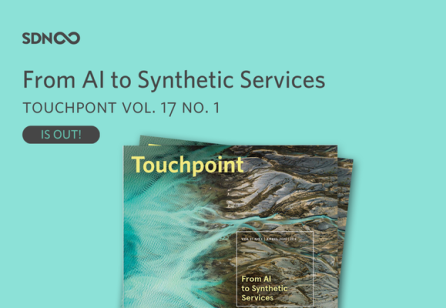
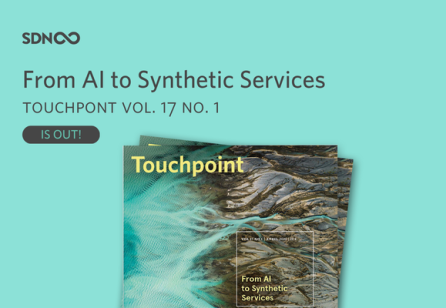
On May 20th 2026, we are holding a special event connected to the publication of the most recent issue of Touchpoint, the journal of service design: Touchpoint Vol.17 No. 1 | From AI to Synthetic Services.

Continue reading
SDN Chapters Register by May 15 for the maximum Early Bird discount!

Register by May 15 for the maximum Early Bird discount!

Connect, Collaborate, and Create Change – SDGC26 Awaits! Join us in Wiesbaden, Germany and online, 28–30 October. Registration is open, with Early Bird tickets on sale until May 15.

Continue reading
SDN Chapters From AI to Synthetic Services

From AI to Synthetic Services

AI continues to disrupt our work as service designers, fundamentally changing the way we design, deliver and analyse services. The advances are rapid as well, presenting new opportunities while at the same time forcing us to answer some challenging questions on where and how its capabilities are deployed. This issue of Touchpoint answers an ongoing need in our community to learn from each other - as well as those outside our field - to confidently apply AI, as well as know where it should be avoided.

Continue reading
SDN Global News Become a Certified Service Design Professional at the SDN Academy!

Become a Certified Service Design Professional at the SDN Academy!

Created for service designers with 2+ years’ experience, the 8-week, 8-module course offers you the chance to strengthen your core skills, expand your capabilities, and earn Professional Accreditation.

Continue reading