Automated transcript
## Introduction and Agenda Overview
welcome to everybody. It's a pleasure to see you all.
We have quite a lovely program for you today. Basically we will do a 2025 year review of the Service Design Network, chapter Switzerland community, and we'll do four things. We'll go over a few of the insights that we covered in this year through several webinars. Then we'll get into a moment where you can share your own Service Design insights.
We will then give you a little bit of an outlook in what happens in 2026, what is a tiny little community? And then on the last bit for those who wish and can, we'd be happy to hear a little bit, what are your wishes for 2026? But.
## Purpose of the Gathering
The question is always, why are we all together here today? So let me give you just a few pointers about what this is. We are here joined. We are here together for. This sounds very pastoral. We are here together. It's one of those moments where you say, we are here together to marry Brian and Mario.
But no, today we are here to marry two aspects of the vision that the Service Design Network, Switzer Chapter has. One bit, which is to part Service Design on the map of Switzerland and the second bit, which is to part Switzerland on the map of Service Design. And these webinars are an occasion to do both of these things, obviously, but we do quite a few more things and you will see that also in the outlook for next year.
That's why we are here at the Services and Network. Switzerland is organized by volunteers, so this is all stuff done by people who love this way too much to be paid and they have way too much fun doing it.
## Insights from 2025 Webinars
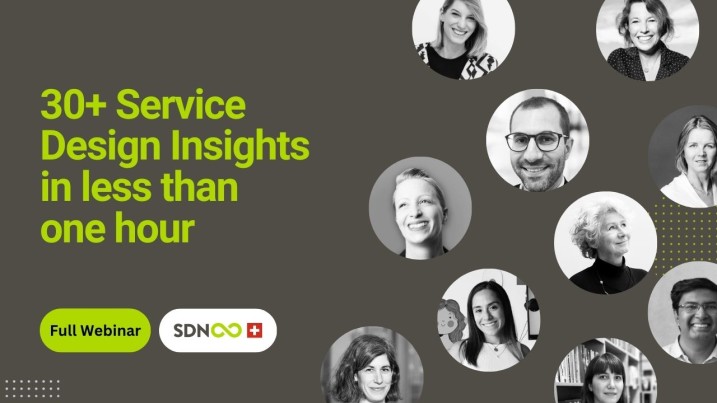
So let me come to the nitty gritty, the inspiring stuff from this year. So we selected I think around 36 Service Design insights that we collected from the webinars that happened during the year.
So if you miss some, this is really the moment because we put them all in one. We had to make a bit of a selection because we, I think from my account we did 17 webinars this year, plus a full day of conference and stuff done onsite. So there is way, way too much. But we made a kind of.
Selection. But still we love even the other people that we didn't showcase here. We just didn't showcase all because of the sake of time for today. But let's get started and we'll go from what happened just right now to then go really back in time up until January.
## Aaron Joseph Martin's Learnings
A months ago we had Aaron, Joseph Martin, who came to speak around his learnings from prototyping and journey management study group, and if we pick three learnings from the, or three insights from that session.
The first one is really this tension that when you build a study group with other services and professionals or nerds there is a challenge that you need to solve, which is. Are you playing as the organizer or are you playing as the learner? Usually if you don't say that well in advance, there is a risk.
That's just because of the fact that you are inviting people, that suddenly there is an expectation that you are in this organizer role. And so this is a thing that Aaron really discovered through his own experimentation and the value of. Of making very sure that this expectation from his side and the side of the people who joined this study group are crystal clear, which brings us to his second insight, which is the value of being ex very explicit of what do people get from this study group.
But what do people have to bring also? So it's both, value proposition, and value giving. It's a going in both ways. And I think this is also something that was quite inspiring, where making this clear from the start creates a very strong relationship. Another point which was extremely interesting was he had a whole take around just the cultural dynamics where depending on the cultures, there might be an expectation that, oh, study group is linked to a specific way of study.
So study group might be, we are gonna read together. In another culture, it might be we gonna spend time having presentations together. Another group might just have, it's gonna be a chitchat. And this is cultural also just of learnings, from one university to the other, depends on where you studied, but also from countries and other types of cultures.
The kind of expectation setting and understanding that there are very different cultures. Is there again, something very important. Knowing also that there are specific cultures where people don't feel at much at ease being in front of an audience, even if it's on an audience of four or five or six people.
And so knowing how to manage that is definitely something important and making clear to start. What will be a challenge for each culture and from which culture people come from? And especially asking the question because there is one beauty, which is sometimes we imagine I have that with Swiss police sometimes.
We when they stop me in the street, they ask me from which. Southern country I'm coming from. And then I have to say, I'm a Swiss German because I have an Italian name and I look like that, and so sometimes just asking like, what is the culture that you benefit in and what's your culture of learning is something that can be very important.
So that was. The, a session with Aaron and took the call to action that I find, which was very inspiring from him, was this call to action to say if there is an emergent topic that you feel is coming and you find no books, you find, no course nothing, just grab a group of curious people with you and.
Study together in any way that fits you better. Can you be through presentations, can be through trying things out can be by doing a bit of research. But if there is an emerging topic, get a group of people with you. It makes learning a little bit more fun.
## Choreographic Thinking with Katherine Klow
Moving on with the event with Katherine Klow.
So Katherine Kolo is she is someone who's a consultant, but also a professional wing. Foil thing, the thing that does like that on the sea. And she is also a choreographer, so who did that in for operas and things like that. And she has this whole bit around choreographic thinking for Service Design.
So using choreography as a way to. Ideate to think about stuff. And the whole, one of the most important points that she shared with us is really this idea of the body thinks beyond the brain and it's faster than the brain. There are things that we can't express with words that we can't express with drawings but that we can express with movement with our body.
And so therefore, she pushed us to, to reflect on how can we use the body as both an element of ideation, an element of analysis. How do I feel in this situation? How do we feel as a group? And so that was something that I feel was very important. And it goes a little bit beyond I think, the notions of body storming and things like that because there is really a notion of, we like this choreographic movement, like group movement, this and movement, which is much more free. And yet that brings us to the second point. One of the exercises that she often gives is as a start, put some constraints in just to help people. Get it, which means that, for example, one of the exercises that she shares is to tell people there is two rules, which is if you go in the di in this direction, in the room, you have to walk.
And if you go in that direction, in the room, you have to run. So fast slow and fast, and that's just two very tiny things. But then suddenly the group starts to do something and there starts to be something that happens quite interesting bit. What I highly recommend that you watch it. Back. She's much more creative in her description.
She has very good examples to that she shared. But one piece that I would keep for me personally as a reminder, was this thoughts that she said in a world of ai, which can mimic language, which can mimic our capacity to draw in our cap in our capacity of synthesizing data. At least for now, one of the things that.
Robots can't do that well, is use a body to feel express, think so that was a thing that I found quite interesting in her framing of looking at. Maybe the body is, at least for the next few years, one of the differentiator outside of our capacity for language, which often in history we say, like the difference between animals and dust and machines is our capacity for language.
But that has a little bit changed over the last few years.
## Service Design in Everyday Life with Lely
Now moving to Iran we had Lely. Lely is someone of the community who has been extremely present throughout, throughout the year, and and she has or brought us in a topic of using Service Design for everyday life. Not putting, making this difference between the tools that I use at work.
I use them at work and they don't are used in my personal life. And so she showed us a few of her techniques of how she uses Service Design skills for personal life situation. One of the things that she did was as a. As a Service Design practitioner, she uses a sort of self interview process.
You could call that journaling, but rather, but formulated as if she was interviewing herself, which means, writing the question, putting down the idea answer, but then not just leaving it there like a journal. But then doing the analysis, like I use like a researcher, coding the interview, going back through it, analyzing the links, what is said over a few months.
So that was quite an interesting bit of seeing how you can use that scale to then bring it back in your own life. Could be seen as a bit of a self-therapy exercise. But here framed as I'm good in interviews. I do that all day. Why not interview myself? Another aspect that she uses is these big whiteboards where often in, in big complex projects, we have these whiteboards where we try to see an overview, maybe have a kanban of what is happening.
We try to have this big thing outside of our brain and usually having a mix of sketches of words and elements on it. And she saw that for her managing. Kind of personal projects like that which is really something that helped her out quite a lot. And just to pick another one, it's this notion of sketching the situations.
So she told us about a few life challenges that she had. She lives in a country that has seen war, that has seen quite challenging situations. And she told us about this power of just sketching out what is the problem of the moment and making it visible. And then to be able to say.
Okay, now this is the part that is in my power to, to change. And I'm gonna focus on that. And maybe that part is not in my power and that's okay. But by drawing it and seeing the system there is like a relief of, I at least can make sense of it. It is not anymore this doubting thing. Moving back to Switzerland.
## Branding and Service Design with Valentina Rashly
We had Valentina Rashly who explored the mix between branding and Service Design. She's working as a brand and Service Design consultant in, in, in an agency. And she shared with us quite a few elements. And one of those, which I find quite inspiring is this this question or this thought that the true brand identity is not the one that is.
Experienced, through great brand kit, colors, logos and things like that. But it's really lived through the experience that the customer, the patient, and so on has. So that was quite an interesting reflection to say this Service Design, customer experience is definitely also part of the brand experience yet.
She had this notion of the delivery graph, which is this classical thing from Bain Company that you can Google out, which is, I might get the numbers wrong from memory, but basically it's it said that. 80% of companies believe that they are offering a superior ex experience. But then when you would ask the people who use these services, only 20% will agree, which shows that there is really a gap between what we believe we're offering and what people really feel and experience.
And that's a very important reminder I think, for both brands, people, and also service people too. Know that yes, these things are important, and yet we still struggle quite a lot. And one of the solutions that she shared is this importance of even in a world where. Brand people might maybe be in the marketing team and experienced people might be in another team to still create these moments of sharing the knowledge, moments of sharing the.
The language also so that these people can slowly but surely talk to each other. And that's a small quick win. It's very simple to do. Doesn't need to change the whole company around. And yet that has still beautiful results in being able to really have a good understanding as experienced people.
To create something that fits the brand and as brand people to know what are the real pain points and so that the brand promises are expressed in a way that fits the real lives of people.
## Service Design Book Recommendations by Aaron
Back with Aaron. So Canada, this time Aaron came twice this year. We've he felt very generous and we were very happy for his generosity. This is a Aaron is running this community of Service Design the Service Design books club. And he shared with us a few recommendation, answered a few questions, but basically if we will summarize his kind of recommendation for beginners he would recommend that people read.
This is Service Design Thinking and designing the invisible as two books to start with. For people who are more advanced in their career, he really recommends the experimentation Field book and the book Experimentation Works. For people who want something a bit outside of Service Design to book what's your problem?
And the other one, which is the VP of No quite a beautiful title. And when we asked him for what is the underrated book that he would really recommend is Generations at Work, which offers this kind of guide for people of different generations to understand. What are the expectation of a younger generation, of a more senior generation about how coloration happens?
Expectation about how, trust is shown, how appreciation is shown, because these things obviously are very different from culture to culture, but also from generation to generation.
## Designing from Scratch with Li Graph
Li graph then shared with us, and that was during the Service Design week, which is a full week where each day we have a tiny lightning toll, 30 minutes, three insights, and three questions from the community. And her session was about designing from scratch and Service Design. And she shared a bit more about like the business side and how you can use Service Design to to start your own business and also be of your of help for the business decision makers.
One of the elements that, that I really appreciated is her parallel view of saying we have to speak with decision makers and we want to do our research before making decisions. And yet decision makers have some ideas already and sometimes they're based on 20 years, 30 years of. Knowledge which are expressed in an order, if we can say it like that.
And so her recommendation is to not just say wait. We need to do the research first, but rather do this in parallel and say, yeah, beautiful idea. Let's test it out. And in parallel do the deep research, which is a sign of respect for the years of experience that people bring.
And yet there is the, this kind of very professional ethic of saying we still need to do some serious deep research just to validate things. And if we validate things from the testing perspective and from the research perspective, Hey, that's beautiful. We are we're then all good. One differentiator that she makes about kind of customer problems, which I find also very in inspiring, especially in the way that she frames it, is to make a difference between painkiller problems and vitamin problems.
Painkiller problems are problems where I feel the pain and I know I need to get my aspirin. Vitamin problems are problems where. I imagine it will do me, it will do good if I take this vitamin and in the long term it might really help me live a few years more, but I can skip it now. I will not die tomorrow out of it.
And I think it was very interesting for me to see how she said it's very important, especially in business settings, to be able to see which are these painkiller problems. In order to create some momentum and to pick those ones doesn't mean that we don't work on the vitamins but to create like a story around the painkiller problems to create the momentum so that we then also have the opportunity to work on some more vitamin problems.
And in short, the whole aspect that she shared I think is also this aspect of saying. Business and Service Design are sometimes people on the same worlds, but on opposite poles. And it is important that we recognize that there is a gap of language. There is a gap of metaphors. There is a gap of methods, and.
Sometimes the best way is just to learn the language of the other, to speak in the language of the other. And that's an definitely an important thing if we want to be of better service for those who make decisions.
## Community and Service Design with German President
We had also the pleasure to have from Germany, who is the president of the Service Design Network, and she gave a talk around community and Service Design.
Three of her lessons were this building for the Common, so really looking for how can we just build something that is a shared space, that is shared knowledge that belongs to everybody, which then brought her to. It's not just about being of service, but it's also about if we design a community to then let the community take charge, take ownership of what we create.
And an interesting take was this kind of opposite view where sometimes as community as communities, we want to bring people within the community instead of. The community goes where the people are. This is not the story that she shared, but that I'd like to share, which I think represents that quite well, is the classical problem of church.
Of modern church today. A lot of modern churches have. Made the decision to go outside of their buildings and to be present with the people instead of say, come in this big building, which is called, and that looks very strange. So instead of making people come to you, go to the people,
Julia back to Switzerland spoke to us about this.
## Internal Stakeholder Needs with Julia
Importance of, or maybe this paradox of how Service Design professionals are extremely strong in understanding user needs, the needs of. External stakeholders, but sometimes struggle to understand the needs of people who are internal. There is a bit of a separation.
We're very good at understanding people who are outside the organization, but sometimes struggle with the people within the organization. And her recommendation was really to say, look at people within with the same tools you already master. A little bit like Lely told us in the everyday Service Design thing to say you already have the tools, the ways, just use them in another context.
Then she really shared this aspect that for stakeholders, business people within large organizations, there is really this language gap where. Design language, sometimes strategic language is not fully understood and there the opportunity to simplify through storytelling. Strong visualization. One pager documents is something that really helps instead of these beautiful service blueprints that we love making, but that then many don't understand and feel like yellow Leaf, she proposes instead to say let's be, let's summarize, let's synthesize, let's give the most important bits.
And let's be clear that not everybody needs to have all the tiny details. Finally, she really pushed us and that was a bit her call to action, to not just have prototypes, artifacts that create a sense of information that people understand what is happening, but also that, that we create prototypes that bring people together and in one vision where they say, we really want this.
And everybody can say that's the thing that we would like to see. In the future, and that can help also internally to convince more people.
## Transitioning from Studies to Professional Life with Camilla
We then had Camilla, who is an alumni of the HSLU Master Service Design who is working as a Service Design professional. And she shared a little bit what it means to study Service Design and to also transition from studying to becoming a professional. And one of the tips that. She shared, which was very strong, is this aspect of when you start your studies, having somewhere written, your personal why of why have I decided to come here?
Why am I choosing this topic? To explore is something extremely important. As throughout a master program, you are challenged quite a lot. You are challenged by your peers who do all of stuff. You are challenged by your mentors, the teachers who say, nah, have you really, is this really the topic that you want to do?
And so still taking the feedback but not forgetting the deep reason why you are coming here and to bring that why back. Because in the middle of the work we might forget. Where did we want to go? Obviously the way can change, but where we wanted to go is an important reminder. And I think that's also something that is extremely important also for professionals.
Reminding ourselves, why did I choose to work in this company? What was my, in my initial motivation? And that brings us also to this realization that there is a honeymoon phase in studying, but also in working. And that's perfectly okay. But we also should recognize that it'll end and that's also okay.
And that then reality comes in. And then we see the parts that don't work, the parts that we maybe don't like. And that's also when this personal why comes back, which then lets us realize for this why I'm still okay to live with these issues. That's okay. It's a good price. It's an okay price to pay.
And finally her as her final aspect was to really seek for the friendship, the community, the people, and choosing the people and staying with the people that can challenge you, that can comfort you and that can support you. And to be really clear on when to go to rich people and to build that community around you.
Back to Germany.
## How Not to Sell Service Design with Isabel Frencher
We had Isabel Frencher who spoke to us about how to not sell Service Design. One of the aspects that she shared was really this switch of not speaking about Service Design at all. This doesn't matter. That's our tiny in backstage cooking mechanism. If you use a spoon of 5 25 millimeters versus 80 millimeters is not really what matters.
What matters is will the cake. Be tasty. That's really what matters. And so she really proposed to us to forget the language, forget the persuasion, the evangelization, but rather really focus on what is the problems that we can solve for the people we serve? And let's speak about that. And she's very clear also about the kind of ambivalence there is when doing Service Design work in organizations, because Service Design work is often quite transformative, and yet we're working in organization that needs to see change happen fast.
And there is an ambivalence, and yet she showed us this importance of being able to play with the quick wins to create the momentum. One aspect that Isabel saw a lot of potential for is this idea of journey management and all the practices that come with it as a bit of a translator or kind of a Rosetta Stone for.
Service Design and business where journey management as a practice has a lot of the language and understanding that business people can have, and therefore she sees a lot of potential there. And also potential for growth for the Service Design professionals to scale a little bit more their impact to the whole organization.
## Hospitality and Information Systems with Mario Saba
Last but not least I'm very happy that we have Mario in today also as a, as a representative, and we have it now also here on the slide. So we had Mario Saba. Back to Switzerland. We had to finish with someone from Switzerland, obviously especially with a topic that is very dear to us in Switzerland which is a country of hospitality, political hospitality.
Also with the Alps where we have this hospices Mari can tell you a lot about that, but he had this topic around touching the substance of hospitality through something that can sound. A bit, a little bit provoking information systems. How those do these things fit together? He had this interesting take around that hospitality is about removing the mery from every experience.
So in a world of ai, slop, slop in general and ification it's quite a beautiful way to see hospitality as maybe a cure for, against the mediocrity. One element that especially inspired me is how Mario really bridges together multiple fields. He has kinda like this triangle between the experience side, the inf this, the information side, and then the hospitality side, and he bridge, he brings that all together.
And to me, I feel there is really some. Big potential for learning for Service Design professionals to explore what can information systems teach us about the services that we are redesigning, the processes that we are optimizing. And then he had this beautiful story about where hospitality started with this notion that it didn't start in hotels, but in hospitals and this notion that.
In the end, what hospitality maybe is really the fact of treating people with dignity at. Every moment, but also at their most vulnerable moment. The hospital is usually the moment where you're the most vulnerable. You're in pain. You are in a place where you are between life and death. There is a lot of clarity, and yet you're treated by the nurses.
Is in a way that you feel gives you back dignity in that moment where you're lost. And I find quite also inspiring. Another quote that he had, which was even I think if I remember well, and he can then correct me, but that even in war, we should need hospitality, even war needs this showing of dignity which was quite an imp inspiring element, especially knowing.
The year that we've been through with quite a few wars. But so to end up on the high note, it's really this importance of the hospitality and going back also to the origins of this hospitality and the history of hospitality. Hospitality, which is very rich. And and I feel it's for me, always inspiring to see that there is a rich history for our field.
Before even our field was born, the bridge, a history, it's like with kids, they come to the world, yet they have grandparents, they have generations behind them that they didn't know about, and they feel hospitality is like one of those, grandparents, which maybe we don't know about in the world of Service Design, which we could go and look for what it can teach us again.
So these are 36 insights from 2025, which is quite a lot. And obviously there is way more, and I'd like also to be very clear that all of this knowledge is available on the website. There is way much more you can go back to to the videos. And to me, I hope that this gave you maybe a taste for one or the other webinar that you say, I really want to watch that one that I maybe missed or rewatch it because it gave me this taste of the one about.
Everyday Service Design from Lely. We want to watch it, the one about hospitality from Mario. We want to watch it again.
## Conclusion and Future Plans for 2026
What's coming in 2026? So in 2026, we have quite a big plan. We'll continue to have as the Service Design Network Switzerland chapter, still one webinar a month as our promise.
It's bit, a bit this pulse that we create in the community. We will have before the 1st of June, a full week where we do a world tour of Service Design. We are going go we'll have seven days where each day we go in another country remotely with a guests from a co Service Design community from somewhere else.
We'll have Canada, we'll have Iran we'll have. Touching wood Singapore, we have quite a few beautiful places. Mexico the United States and so on, who will be represented, and we are very eager, especially we have this plan that they, that each country teaches us about. One thing that they do in a different way or one cultural aspect that is different and that changes their perspective of what Service Design is and one, how it's practiced, which I'm very curious about.
Then on the 1st of June, we have our classical Swiss Service Design day for those. Can come to Switzerland. Please come then. The weather is beautiful. The people are lovely. And we'll have a day, which is a bit of a family reunion style gathering. We limit it to a certain number of people.
This is not your 200 people 2000 people. Kind of conference. This is more a family gathering. We want to be able to know each other all by first name. And it's quite a beautiful moment. And then in the backstage, something that maybe will be less visible. We are resetting kinda the administrative side of the association for.
Now, a few years we've been in grassroots mode, just pushing that this committee has again, a pulse. And and we were very happy that this will happen in the last years. And now we need to kinda reset up the whole association bit, kinda the official and formal things. And with that, we will then open also and election process so that maybe there will be a new leadership if people wish for that.
On the family gathering aspects there is. I will share that then in the chat and in the description of the recording. But there is already the full day of the service Swiss Service Design Day conference. June 1st is already programmed with all the guests, talks, workshops which is I think, a testament to how Switzerland works.
Time precise six months in advance. So we really appreciate that all of these smart people will come and will speak, will have a lot of stuff around inclusive services, everyday Service Design.
## Audience Reflections and Testimonials
Now I come to the question what is it that you had as a highlight of learning or experience in your Service Design journey in 2025? If there's something that you wish to share I think that would be beautiful. I will allow myself to maybe ask to Layli because I know she usually is okay to be on camera. So I allow myself to ask you, maybe you lely is there, what is your insight of this year? If there wa you had to pick one, but you can also share more if you wish.
Hi, Daniele and to everyone. Actually in 2025, I participated to all events of Esteem Switzerland, except the one that belonged to Mario Saba. That was so unfortunately because I was driving in the I was on the road and I couldn't, I had a poor connection and I missed it. And, I should say that two days ago I had a speech in the University of Tehran about Service Design.
I was invited there, and I should confess, I must confess that I was completely armed with a wide perspective about Service Design that I, I. I received from these events that these webinars that I participated during 2025 from services, actually SD and Switzerland, and like the question and answer part in that like speech from students was like.
Playing in the playground for me because I had I had this experience of having question answer from many different perspectives that that you mentioned even now. And it's really. Expanded my perspective about Service Design, and I have many topics now to talk about, about, because the reason that I participated to these events was in the, at the end of the, like 20, 24, I was, I felt so alone about being grounded by service designers and now I'm so rich and I am really.
I'm thankful that you made this opportunity for me actually to become the one that I am now and I'm really happy about it. Wow. Thank you so much. That's a beautiful testimonial. Maybe to me, there is a beauty that I would like to acknowledge here, which is this beauty of, abundance is sometimes a click away.
The abundance of relationships of diversity of different thoughts. This abundance is sometimes just one click away, which is register what? It's a few clicks more. It's register, put the email, say yes, and then click on the zoom button. Ah, so it's three clicks away. But that's quite a beautiful thing to, to see that when we are in these situations of.
There is not enough. We can, with a little bit of effort, we can really get there. That's a beautiful insight for 2026. Thank you so much, Le, we appreciate it. You welcome. Yeah. Maybe Mario, I will, as you are a past speaker and I spoke a lot about you. Maybe you have also something that you wanted to share with the community.
Thank you so much. Yes I would be having something to share with you. This, your network is a place of transversality for me, like it is where, and that's why I'm here today because I like conclusions. It was the moment to be here because you have spread all the things that you have done during the years, and I can see.
How much it is rich. And already, if I look at you guys here on the screens, everyone has different background, experience, perspectives, and this is the thing that I seek. And Swiss Service, Design Network like to be more concrete. A after our we have, I spoken with you in February last year, I think, and then after that I had the idea from that openness that I've taken like from.
Your way of doing things. I said to myself, okay let's go back and do something related to past experience I have had. And now that we have someone from Seattle, maybe it'll make sense for him also. I used to be to I was in 2019 in Seattle and then. Because I'm faculty at Washington State University and then I went to Seattle to visit and then I saw that there is a pike place, the public market, the fish public market, and there I was astonished by the experience you get there when you go to the fish market because it's.
There's no other fish market in the world like this fish market where normally what people go and do in the fish market, they go and maybe they will buy fish and then they go cook them. And then, but there, no, you go and you see a show and I have seen a show people playing those fishermen. They were processing fish, displaying fish.
They are real authentic fishermen. But they know how to sell fish more than any, anybody. And then at that moment, 2019, I didn't know that there is something we call fish philosophy and that there has been one book published since, back in two, 2000, year 2000 on the FISH philosophy. And then, so I was late on the fish philosophy.
However, like the exposure with you guys and this. Networks with design made me wanting to try something, which is taking the fish philosophy and applying it on something else. And more precisely on hotels, hotel management. I will not say the name of the of the hotel chain that. I spoken for.
And then, yeah, I found a way thanks to you guys to get back to a past experience I had back to 19 2019, and then convert the fish philosophy into something we can use to solve problems in a chain of a hotel in Europe. So to make it very quick in the fish philosophy, there is a notion of play.
Yeah, we can play on the workplace okay, we know how to play with the fish. And then they were throwing fishes from big fish, like from 10 meters, one to others, and you know the fish is sleepy. You'll, it's so difficult to throw and get the fish, and then play on the workplace.
There is a way, yes, we can play and that is touching hospitality in somewhere. Be there, there is another notion that says you should be there for your client and be there as those fishermen were for our, their clients. Selling fish. Be there when you are medical doctor listening to your patient. Be there wh when you are an reception receptionist in a hotel or in any public administration.
Be there where you are a garages and you won't, you fix car for others. So there are lot of conversion model that we can take from that. And then what I retain also like play be there and then make their day, make the day, make. The day for your client or anyone you meet with, there's a way you can make his or her day.
And then I was like pleased to convert that into specific market, into specific need into specific business field. And that was. European Hotel chain and yeah. So all that it's all about openness. This is hospitality. One of the roots of is being open and you guys bring. To the people the motivation to be open day after day.
So thank you. And then this is how, you helped me to bring new methods on the, on, on the menu and new business and I'm so happy.
Beautiful. Thank you so much. Mario Fish philosophy, the. Openness of seeing all of these different ways of working the heritage going back to what we have experienced and bringing it back to today. Yeah, recontextualizing it, and these are very powerful elements.
Thank you so much for sharing these inspirations. It's a joy for me. I have this secret plan. I have a lot of secret plans. One of the secret plans I have is, for me, the one thing that is important is that in communities like Service Design community is to propose not it has to be like that.
But rather to open the minds and open the world of possibilities where people realize, wow, I could dance and do something, which to me feels very weird. But for someone else, I could do, translate that in business language and I don't even have to speak about my trade. And to be in this world where we can learn from someone who is a dancer, we can learn from someone who is doing hospitality.
We can learn from someone who is another Service Design practitioner. We can learn from someone who is in business. And these things for me are something which is quite important. We come out a little bit of our silos of thinking, thinking just business thinking, just experiential thinking, just artistic, but that we try to at least hear the other perspectives.
Maybe try to dabble a little bit in them also. And so what I hear from both you, Mario and lately, is that it gave you this. Taste to play with other philosophies, fish philosophy but also to see that there is an openness and that then we are not anymore in this. When I have to teach as Lay says, I don't have to teach in it is like this, but rather here are the options.
This is maybe one that I appreciate a lot but here are other options and I think that's a beautiful place off. Abundance. Beautiful.
## Closing Remarks and Gratitude
Hey, I really appreciate all of this so much.
Thank you all for joining. Thank you all to you for re-watching this in between some Christmas parties with a stomach that is hurting. But I hope at that your ears are very ha, happy and open. I thank you so much to all of the guests that came this year.
There are way too many people to mention, so I will not do the mistake of forgetting someone, but I'd like to really thank you all all the people also in the backstage that are making these events possible, there is quite a lot of organization Thank you. A lot of, to all the speaker workshop facilitators that came in this year.
Each time it's quite a lot of preparation for them. And they have to work with someone who sometimes asks them one year in advance to do something and to block their calendar one year in advance, which is also sometimes a bit of a challenge. So a big thank you to all of them. I think queue also for, to all our elders, if we can say it like that.
The people who started these organizations are very much thankful to all of them, and especially thankful for all the people. Who joined, asked a good question, asked a provocative question, added, an insightful look and addition that made everything smarter. And that just by your presence, gave meaning to these moments because if there is nobody to serve, is there a service?
And thank you so much for helping us. To be of service. And thank you so much for being of service also with the community in general, as I've seen many beautiful stories of people that then connect after such sessions and then continue collaborations. So a big thank you to all of you. Thank you for a beautiful year, 2025 from the site.
Of the Service Design Network, Switzerland a big thank you for all what you did for all what you did for the community. And from my personal side, I wish you all a beautiful end of year in whatever type of celebration that you do in your country culture and way of living. Thank you to all for joining. It's been a pleasure. And for those who want to stay, you can be, stay a little bit longer. Let me remove the recording.
This transcript was automatically generated using Descript. There are still mistakes in it as we didn't review it further by hand. Take it with a grain of salt.



Share your thoughts
0 RepliesPlease login to comment