

Lúcia Sousa
Author - Lúcia Sousa

Two minutes saved per report, multiplied across 10,000 reports a year, returns 40 working days to the organisation. That's what service design does, and it starts with how you understand the system.

The shift


We moved from a profound industrial production economy to one largely centred on services. As the World Trade Organization and World Bank note, “the services sector’s share of global GDP increased from 53 per cent to 67 per cent between 1970 and 2021” (Trade in services for development, ch. 1, p. 15). Today, most of our time is spent interacting with services rather than products: banking apps, healthcare systems, public transport, digital platforms, customer support, education, and more. A product is something you own; a service is something you experience over time. We have moved toward what can be described as a servitized economy (Vandermerwe & Rada, 1988).


This shift has real consequences. Most new companies are service-based, and so are most of the jobs being created in this ecosystem. If services are increasingly present shaping our daily lives, designing them well is no longer an option. It is essential. And thus, Service Design.

So, what is service design?


Service Design ultimately cares about ensuring that real value is delivered to users and organisations. At its core, it is about making sure a service works meaningfully for the people who use it and the people who deliver it. As Sarah Gibbons from the Nielsen Norman Group (2017) puts it, “service design improves the experiences of both the user and employee by designing, aligning, and optimizing an organization’s operations to better support customer journeys.”

In simple terms, service designers provide the helicopter view of a service, connecting the dots across business, user, technology, data, policy, legal - and whatever else is key to deliver the intended service outcomes. The work is inherently collaborative: it helps establish the service’s objectives, then identifies and coordinates the essential components that will drive these outcomes for all parties involved.


The systems-thinking mindset and its components.


A service design approach is holistic. It’s not just a toolkit or a sequence of workshops. It is first and foremost a mindset. As Birgit Mager explain, “it looks at systems and subsystems of relationships and interactions. It takes the context into consideration, being aware that services are living systems.” (2010).


And this is sometimes where things may go wrong. Often, as humans, we tend to focus on the visible or tangible parts of a system: isolated moments, individual screens, single touchpoints, rather than understanding the service as a whole. It requires critical thinking and a lot of curiosity to comprehend the wider ecosystem in which those interactions take place.


To make this complexity visible, service designers often use artefacts such as service blueprints or ecosystem maps. These tools help visualise how people, processes, technologies, and policies connect across the entire service journey.


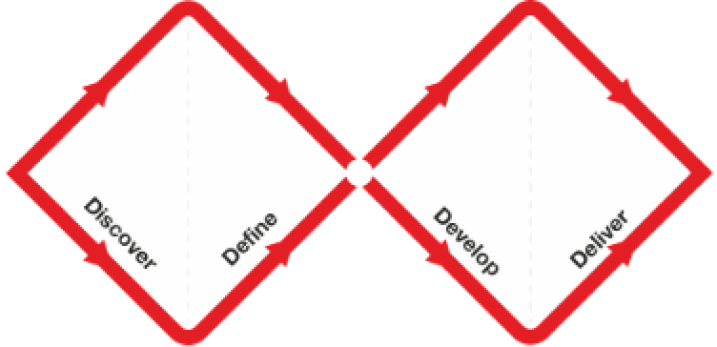
Another common shortfall is jumping straight to solutions without first developing a shared understanding of the service. This is where the service design framework and its methods come into play. It’s important that the activities developed are guided by a systemic, human-centred perspective, rather than speed or assumptions. That's where structured process frameworks become essential. One of the most commonly referenced is the Double Diamond design process model, popularised by the British Design Council, 2005.


Figure 1: The Double Diamond design process model. Image from “Double Diamond,” by Design Council, n.d., Design Council (https://www.designcouncil.org.uk/fileadmin/uploads/dc/Photos/banners/Double_Diamond.png). Copyright Design Council.

The model guides teams through four phases: Discover, Define, Develop, and Deliver. It encourages divergent thinking before converging on solutions, regardless of the specific tools or methods a team chooses to use.

Seeing it in action


To see how this works in “real life”, here’s a mini case study:

Recently, at my company, I worked with a regulatory public policy body in the UK. One of the biggest improvements we achieved on the service was reducing the end-to-end journey from around 12 minutes to 10 minutes. We did this by identifying friction points and admin-heavy tasks that could be streamlined.

On the surface this may seem like a minor improvement, but at scale this is very impactful. This service produces more than 10,000 reports per year. Saving two minutes per report equates to 20,000 minutes annually, which is more than 330 hours, or roughly 40 working days of capacity returned to the organization.

The gains were felt by both users and the organization. For users, those two minutes meant a faster and less friction-heavy experience when completing their assessments, which is often under tight deadlines [14-day window]. For the organization, it meant an efficiency gain, and, of course, freeing up time that can now be invested in other strategic pillars.

A small drop in minutes, but a noticeable and substantial impact when multiplied across the system.


TL;DR


Service design is, at its core, sense-making in complexity. It helps organisations navigate uncertainty by understanding how people, processes, technologies, policies, and contexts interact over time, and by making those relationships visible and actionable.

So next time you pick up your phone and use an app, pause for a moment. Think about the service behind the screen. What small things could be improved, not only for your own experience, but also for the business delivering it?


Bonus

Many people have tried to answer the question of what service design is and why it sometimes fails. I find this cartoon by illustrator Virpi Oinonen to be an engaging and accessible way to explore that complexity. Check it out! https://www.businessillustrator.com/what-is-service-design-cartoon/


1. Mager, B. (2010). Service design – An emerging field. In S. Miettinen & M. Koivisto (Eds.), Designing services with innovative methods (pp. 27- 43). Kuopio Academy of Design.

2. World Trade Organization & World Bank. (2023). Trade in services for development: Fostering sustainable growth and economic diversification (Chapter 1: The future of trade lies in services: key trends). World Trade Organization. https://www.wto.org/english/res_e/booksp_e/trade_in_serv_devpt_chp1_e.pdf

3. Vandermerwe, S., & Rada, J. (1988). Servitization of business: Adding value by adding service. European Management Journal, 6(4), 314–324. https://doi.org/10.1016/0263-2373(88)90033-3

4. Gibbons, S. (2017, July 9). Service Design 101. Nielsen Norman Group. https://www.nngroup.com/articles/service-design-101/

5. Oinonen, V. (2016, September 28). What is service design? – Cartoon infographic. Business Illustrator. https://www.businessillustrator.com/what-is-service-design-cartoon/

6. Design Council. (n.d.). Double Diamond [Image]. https://www.designcouncil.org.uk/fileadmin/uploads/dc/Photos/banners/Double_Diamond.png


Related Community Knowledge

Education and Research Valuable Networks for Service Design Education

Valuable Networks for Service Design Education

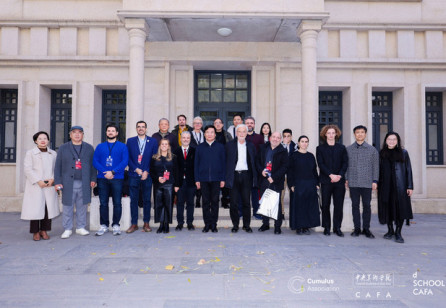
It is in education where we build the foundations for the next generation of service designers and for the future of service design! Since 2015 the Service Design Network is official partner of Cumulus, the leading global association of art and design education and research. One of many opportunities to build valuable networks for service design education.

Continue reading
Education and Research SDN Academic Task Force

SDN Academic Task Force

The SDN Academic Task Force

Continue reading
Education and Research China Higher Education of Service Design Survey Report 2021

China Higher Education of Service Design Survey Report 2021

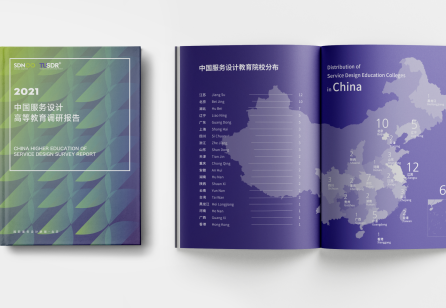
The service design education in China began around 2010, with the Academy of Arts & Design, Tsinghua University, Nanjing University of the Arts and others universities taking the lead in exploring and practising service design education. For response to the needs of industry and the development of design education, service design education has showed significant growth in Chinese colleges from 2015.

Continue reading
Education and Research The limitations of user-centred design when designing at scale: the case of e-commerce.

The limitations of user-centred design when designing at scale: the case of e-commerce.

Why e-commerce is failing people and the planet

Continue reading