Automated transcript
## Teaser
There's a level of almost, arrogance when we invite people to a workshop. Work with them and then they have no idea what happened with the outcome.
So why is Swiss direct democracy worth learning from?
Looking at Switzerland, the highest trust in government in the OECD within 85% approval versus 51 on average. There's a 92.9% on World Bank's Political Stability Index very stable.
Initially people, customers were actually seen as an interference.
Then it slowly became temporary contributors with various types of engagements.
And today we look at them very often as a strategic resource, something that we can rely on.
What is Swiss Direct Democracy? It's a predefined, transparent and binding process to implement proactive and reactive citizen input making citizens in effect, a fourth branch of power.
People have a very strong voice through three main types of referendums.
One of them, this is boring. It's a Mandatory Referendum. The country can't make a decision without getting the people's opinion on it.
For example, Switzerland can't just join the EU without asking the citizens. This is a boring thing. Other countries have it as well. Let's get it outta the way.
The Optional Referendum where you can, as an individual, challenge any law, which, when I first heard about it about a decade ago, it was like, wait, what?
What I think is really the most awesome thing is The Popular Initiative. Where a group of citizens can change the freaking constitution! And just, can propose a blurb to be added to the constitution.
What I want to do, is to turn it into a predefined, transparent and binding process to implement proactive and reactive customer input at commercial organizations.
And I call this the binding voice of customer or BIVOC.
There's a new idea coming from the community. The company likes it with some tweaks, it gets implemented.
## Swiss Thinking Origins
Swiss style the subtitle helps with that, developing a co-creation process based on Swiss direct democracy. So that's the a research sort of project that I did during my MBA at EPFL.
And it brings together Switzerland and Service Design and the whole sort of concept of co-creation. And initially I was thinking like the way Switzerland and the direct democracy works, the way we know design thinking should be, should be called like, I don't know, Swiss thinking or something like that because there's so much involvement in Switzerland when it comes to democracy.
And then, what could we do with that process? So that was the whole point of of the research that I did. So yeah, I won't go further into this.
## Who I Am Today
Daniela mentioned, so I work mostly in Service Design, innovation, business strategy. I work at whitespace, which is a consultancy based here in Geneva.
And we do we work mostly with large enterprises, mostly in the life sciences, but also in, in some other industries myself and more in the life sciences. And we really work with with large and complex projects that span across years and mostly, have to do with the internal workings of organizations.
I also teach at I work human-centered I teach human-centered design there which I really love and really brings a good balance to to my work life, I must admit. Okay.
## Agenda and Co-Creation Vote
And so about today's topic. So I'll start with why Swiss Direct Democracy, or SDD as I'll be abbreviating it.
Why is it worth learning from what is Swiss direct democracy in the first place as we mostly have Swiss people? I'll just touch on that. How should Swiss direct democracy be repurposed? And that's what I'll put the the biggest emphasis on and who would be needed potentially for next steps.
So let's start with the first one, which is, why is Swiss direct democracy worth learning from now I have a question to you because you can't really get around. Co-create the topic of co-creation without co-creation. So I'll ask for a little vote. Have you ever felt like you had a legitimately good idea to improve on a product or a service?
So I should have here a Slido and hopefully it works. So I'll just ask you to, and we have a few enough people for for the votes to be coming in shortly. So just to go to Slido, enter this number. Or scan this a QR code on your phone and just answer. Have you felt ev ever felt like you had a legitimately good idea to improve a product or service?
So far everybody believes that, which is great. I.
Some evening out, but still, yeah, very much on the top. I was just thinking I was doing some I'll admit it. Like I'll, I was doing this late at last night and I was pouring my tea. I was looking at the filter and how it could be like the little metal filter I was putting the leaves in and how it could be improved and like, why don't they do it and stuff like that.
So I'm sure that there's moments like that for all of us, and it seems that there is. So thank you for that.
## Why Learn from Switzerland
So why is Swiss Dark Embassy direct democracy worth learning from? So let me just move this thing outta here 'cause I have a little, and there we go. A few things. So the first one is, so just looking at Switzerland as it performs because direct democracy and the government have a lot to do with that.
So just looking at a couple of stats, is it the highest trust in government in the OECD within 85% approval versus 51 on average? There's a 92.9% on World Bank's Political Stability Index very stable. And there's noble prize winning research that shows that the stability and reliability of a government is one of the things that counts most in in whether a country succeeds or not.
It is a sixth least fragile state, globally per fragile state index. And on some other stats, it is number one on the global innovation index of the WIPO. And it's an innovation leader on European innovation scoreboard. When we just look at Switzerland. Yeah, it sounds good.
Is it really good? The stats speak for it being a proper run company or organization if we look at it that way. And the, it's, is backed up really by some numbers there. If we just look at, okay, but is it performing well? So is it really something we wanna copy?
Probably yes.
## Co-Creation Evolution
Then the next aspect, and this is one of the things that sort of was most striking in the early phases of my research, is how co-creation in general has changed over, the long decades that there's been companies engaging with customers. Because initially people, customers were actually seen as an interference.
With the organization ah, these pesky customers, we need to deal with them as well. They're really seen as interference something that was. Not just kept it our arms length, but really purposefully, kept away from from the organization's activities. Then it slowly became the people slowly became temporary contributors with various types of engagements.
And today we look at them very often as the strategic resource, and that's not just by leading organizations, some of which I'll mention in a bit. But really on a whole, and I think us working in human-centered roles, or I'm guessing here, we really appreciate that and, really look at the customers and the consumers of a company.
I think a strategic resource, something that we can rely on. And my proposal is that this evolution is not over yet. And cust because, customers are becoming in the age of the internet and now the age of ai, they're coming becoming more informed. More connected, more competent and more demanding.
The flood gates have been opened. People are more and more working with the organizations or want to be working with the organizations that they are in some way a part of. So I'm thinking this, will evolve. And I'm not thinking this, on a next year or in five years, level, but really looking for, maybe this will take decades, maybe this will be 50 years from now.
But I'm just thinking that we often, take the way things currently are as the default. And just looking back how much it has changed over, around a hundred and plus years. There's, there's a long time that we can, think and really look into the future of how this will still evolve.
## Process Gap in Theory
And the third aspect on why Swiss democracy is worth learning from, reflects not on Switzerland and not on co-creation as in general, but on the theory of co-creation and sort of the, it's, its elements because co-creation looking at books, articles, research around it. There's a lot of discussion around the drivers, like why Cocreation needed, what kind of organizational mindset is needed for it, what kind of framework the organization needs to be in.
I'll get to the processes in a bit. What the participating customers have, they are looked at, what are the tools? And what are results and measurements around it, which then go up and, increase the drivers. And the thing is that processes is the art, is the part that from all of this is the least addressed in, in co-creation theory and just the way it is discussed, meaning that something that the Swiss direct democracy is very strong at, meaning the process.
Is, is a gaping hole in co-creation theory. It's a good match. So there's something that you know to be learned from.
## Co-Creation Matrix Examples
And the final piece around this, and also, just clarifying a bit, what I mean, or what, people mean generally around co-creation is that everybody's doing it to some degree.
And there's a co-creation matrix that I created based on, standing on the shoulders of giants who, did research around this topic. And then combined it and I created this sort of matrix, which looks at the whole process of value creation from ideation. Through validation, designing, testing, launching production, and then consumption to another layer, which is around the maturity, which goes from passive to reactive to integrated involvement of of the customers.
What I mean by passive is that you as a customer might be involved without you even knowing about it. Or it might re be reactive, meaning the company might reach out to you or it might be integrated, which is really that the organization counts on you and that you can actually step in even proactively.
And if we think about AB testing, web analytics, or any kind of tracking, that's really the passive form of co-creation, mostly in the validation design and test part. Any type of design thinking effort I would argue also fits here. You could argue, fits maybe a bit earlier into ideation a bit later maybe as well, but really fits here.
And then there's a couple of, specific examples. So if you think about FMA Figma plugins or Auto Miro verse in Miro, those are really co-production, co consumption. Those are things where an organization. Produces something and then you as a customer, you also, help produce it, make it stronger, and then you work on it together.
Peloton is a good example as well for good consumption, where the, the whole experience of the training, it becomes real with you and the trainer, co consuming the service. And then we have Firefox, which, branches across a lot of these elements. They have a very strong culture in very closely.
Working with their community, really co-creating the browser and also a lot of efforts around it from ideation to validation, design, production and so on. But also if you think about Lego ideas where you can just, propose a new Lego set to be built that also fits into this ideation validation, and.
Part and Switzerland and the Swiss Direct democracy also fits specifically into the ideation and the validation phase. And what's interesting is that very often you'll find companies, yeah, they do co-creation. Yes. But very rarely in this ideation and validation phase of, what do we actually do?
What do we propose? What kinds of services do we bring to market? There's a good gap here that, that it fits in really at this sort of integrated level.
## What Is Swiss Direct Democracy
Okay, so maybe you don't know what Swiss Direct democracy is. So a quick intro into that. But first another question, whoop another vote.
Do you feel like your individual opinion can influence the organization that you work in? If you work in one currently, or if you don't work in one currently, the one you most recently worked for. So do you feel like your individual opinion can influence your organization? Yes. My opinion and everybody else's can.
Yes, I, but I'm, you might be among the lucky few who can have some influence. And I wish, but no, already have the vote on that. And the, my favorite, that's above my pay grade. Something I think we hear sometimes too often from so clients
very good. So some, a mix as I was expecting. Very good. So with that out of the way, so what is Swiss Direct Democracy?
## Three Referendums Explained
The way that I define it is that it's a predefined, transparent and binding process to implement proactive and reactive citizen input making citizens in effect, a fourth branch of power.
It's really important that, really it's that closely linked into the the fabric of of the powers and really suicide direct democracy is ruled by the people or direct democracy. It needs to be said. Switzerland is actually a semi democracy, like because of department being in there.
Not everything is direct, but people still have a very strong voice in through three main types of referendums. So one of them, this is boring. It's a mandatory referendum. So it's basically something where the the government or the country can't make a decision without getting the people's opinion on it.
For example, Switzerland can't just join the EU without asking the the citizens. But this is a boring thing. Other countries have it as well. Let's get it outta the way. The more interesting one is the optional referendum where you can, as an individual, challenge any law, which, when I first heard about it about a decade ago, it was like, wait, what?
And that is, just just magical in the way that, it, it really puts in a check and balance into the power. So this is a cool thing, and we'll talk about this in a bit more detail, but what I think is really the the most awesome thing is the popular initiative. Where a group of citizens can change the freaking constitution and just, can propose a blurb to be added to the constitution.
An awesome thing. And I analyze all of these processes and look at sort of the break points, the some gains and pains in the process. And that's what sort of led to to the bulk of of this project, which is looking at how to repurpose Swiss direct democracy a final vote.
Do you feel like your individual opinion can influence your country tree? So a final Slido, absolutely. Democracy, all the way to, I can't say I'm being watched.
I am originally Hungarian, and you might have heard that we just had a basically a. A big change in, in, in government. I'm more hopeful about this in, in, in general, in the world. But I do know that, a lot of people are a bit disillusioned with the direction of, world leaders and the way it's, where it's been heading in the past, five or 10 years.
The whole idea around bringing this topic is like a balance to show there are other opportunities, there's other ways of doing it as well. So happy to see a. A bit of a balance there as well.
## From Democracy to BIVOC
And basically what I want to do, or what I'd like to do with, demo cracy, is to turn it into a predefined, transparent and binding process to implement proactive and reactive customer input at commercial organizations.
And I call this the binding voice of customer or BIVOC And what I mean by this is that predefined is basically that there is a process, and this is really an important piece because when there are these books, when there are these. Research articles or theories around co-creation.
They do mention, big ideas and big concepts, and they do a lot of tools, most of which any service designer or design thinking professional will be already familiar with. But how to really bring that into a full process, which has a beginning, middle end, that everything is defined. That's where there's a lack.
And that's where I think this can fit in transparent, is that this process is known to people. And binding is that once it runs, there's no I didn't mean it that way, but that the company really needs to do what, people set out to asking about it.
## 40 Traits Keep Rethink Avoid
Going through the the various referendums, the various processes, I identified 40 characteristics of Swiss Dark Democracy.
And I grouped them into three broad areas. One is participant perspective, the other is the collaboration perspective between the participants and the sort of organization or government. And the final one is organizational perspective, and about half of these. Characteristics in Switzerland's direct democracy process or things that, yeah, those are good.
Let's adapt them into a company. Around a quarter of them are like, yeah, like maybe before plunging into this, maybe think through how it best fits your organization and here are some key things you need to ask yourself. And another quarter of them is yeah, don't do that. Do the exact opposite kind of things.
So just one example to each of these. A good thing that you know should be kept in any kind of co-creation in a commercial organization is clear communication provided including all sides of the debate. So there's the for Swiss people, the famous little Red book, which is shared before every referendum, which basically includes.
What the topic or topics are about that the referent is being held on. There's also, how the parliament voted, what various parts of the government and even what various types of large organizations, which is within Switzerland. Think about that topic. There's pro and con arguments, why this would work, why it wouldn't.
And even there's a list of various political affiliated organizations and how they feel about it. It's not, like in, like it was in Hungary for quite a long time. It's like the government thinks this, so you should think the same, but rather Hey, here's the thing, here's this side, here's the other side.
This is what we think. What do you think? And I think that's just beautiful in the way it's really presented is is excellent. So that's something that should be kept. Okay. Or something that should be rethought. The fact that almost no topic is off limits. And I really love this, and I'll get back to this later as well.
There's this quote. When initially this whole direct democracy thing was adapted in Switzerland, the way they started is that it's all in, like there's no limits. People can do anything. And proposals of the governing maturity were shut down as if with a machine gun, meaning there was, a majority governing and then whatever they did, the opposition is yeah, I'll challenge that. And then it didn't go through, so there was a bit of a stalemate and it led to a lot of new developments in the process. So this is something that you should definitely think about. And then things, something to, to not include is that the initiative, so starting a proposal, proposing a change in legislation in the constitution, in Switzerland.
Yeah, once you do that and then you gather enough votes around it, enough support, and then you actually win, you are basically also just let it go. You are no longer involved. You are not really, consulted. Maybe, in some cases, but the process itself doesn't include you after the point that you have submitted your proposal with enough signatures.
From that point on, you're just a regular citizen, and instead of that, like there should be more involvement to really make this co-creation instead of just, co ideation.
## BIVOC Map and Ecosystem
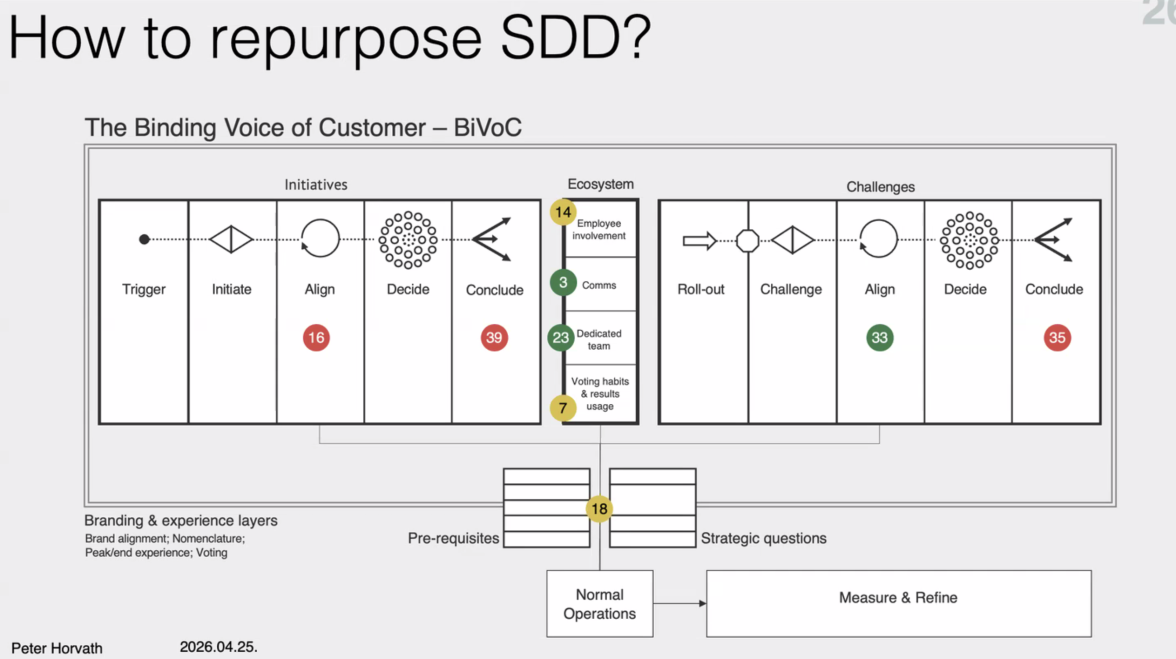
So I'll walk you through the sort of map of of bevo, this binding voice of customer. And really it starts with, and this is really important, like the foundation is normal operations of a company.
The things that they do, normally. And then if they think, okay, let's, try this type of, really. Binding co-creation. I would say that there's this sort of, these two things. There's some prerequisites and strategic questions, and this is what I call a one one directional door.
You open it and there's no closing it again. So basically once you start letting people in, if you dial back from that, that will have a backlash. So this is a really important decision here. I'm gonna do some details in a bit, and then there's an ecosystem that needs to be built out within the organization.
And there are two types of engagements that the customers can do with the company. One being initiatives which is, Hey, I think the company should be doing X, Y, and Z. And then there are challenges. It's Hey, this company just launched a new feature. I don't think they should. I. And then around this, there's a branding and experience layer and a measurement layer as well.
I won't really go into those for lack of time. So going into a bit more detail, so the, we have the prerequisites and these strategic questions. One of the prerequisites, for example, is there's, I think five or six is that the the. Vision of the organization. The strategy of the organization needs to be known internally and externally, and I think it already is a quite a high barrier for many organizations that it's clear what that company stands for because only through that, can people really make sure that you know their.
Proposals are in line with with what the organization is doing. And the most important strategic question is item 19 on my previous list of 40 D characteristics, which is this whole idea around everything goes, and any initiative and any challenge, any topic can be included.
And that's the most important thing. And really, if you think about Lego ideas where you can propose in a new set to be built. There's no way for you to propose that Lego, uses wood instead of plastic or something like that. It's really around just, creating new Lego sets. So they have a very well-defined barriers around what to do co-creation on.
And that's excellent because you need to start small. And now one of the the general analysis around Swiss our democracy is yeah, maybe the one thing we could have done differently is to not start with everything all goes, but start with small steps. And that's really something that an organization should do as well.
Then going into the ecosystem one element there is the dedicated team. So there should be a co-creation team that reports in my proposal directly to the CEO to really show the dedication towards co-creation. And this should be distinct from, marketing or design or UX or Service Design, because this should be really for this sort of proactive element versus the reactive part, which these types of teams most often do.
The employee involvement also needs to be really discussed. In Switzerland, if you are a party member, you are basically have the same powers in direct democracy system as a normal citizen. Now, whether that's good or not has been debated a lot, and that's really a question like, as an employee, what would you think?
If you don't really have any extra powers, but any customer can propose in a way change in the organization. So at least, the employees should have similar processes in place, but maybe even something that's more direct so that the voice of the employees is as heard and is clearly, paid attention to as that of the customers.
Another part is the communications. So I mentioned that earlier, that this should be really covering all elements and I can really see, the the head of marketing, the head of development, having an opinion around a new feature that is being proposed or a or something that the company is launching.
And to really make that clear. And, with company blogs and stuff like that, that does happen with a lot of companies that this is disclosed. But also, think about, things that come from the customers themselves as initiatives, the cus the company should, have a clear communication around that as well.
Another question, and as mentioned there's really a lot of questions in this whole process that the company needs to think through, but one of them around voting is one person's vote, just one vote, or is it worth more or less in some cases? And that's something that I think a company needs to be thinking about as well.
So for example Switzerland. One person, whether you are a billionaire or you are an average Jurgen, it's still you have that one vote. But in a company maybe you say free users versus paid users should have less of a say or some other type of development. Someone who's been with the organization for 20 years in terms of a paying customer should have more of a way than someone who just joined now.
So definitely there some weighing could be introduced.
## Initiatives Workflow and Counterproposal
Another element is the whole initiative workflow, which goes through a trigger, like something that actually starts the initiative, then the initiative being proposed by, one or multiple people or a group of people. And then something that's really different from from Swiss democracy is this aligned phase being very close in Switzerland.
Once you have an initiative really on your own until you gather enough signatures. In this bit process, I really proposed this alignment between the organization and the initiators to be done a bit earlier and really think of it as just, as if you were doing a workshop in a kind of design thinking process, and really have a, an early alignment with, okay, what is it that they're looking at?
To also be able to assist these initiators with some more information around what the company is doing, why something they're requesting is hard or easy. To have that early alignment. Then the other important elements as just to take a quick look here at my slides here, if I didn't miss anything in this one.
One really strong element in this align phase also is the counter proposal, which I think is a very strong thing as for certain degree as well, where there's an initiative and the government can say, I almost agree, but I propose to do it a bit differently.
## Streamlining Decisions
And in case of, this big process, maybe that doesn't make the whole voting at all necessary.
There's a new idea coming from the community. The company likes it with some tweaks, it gets implemented. Then no further process really needed.
## Keeping Initiators Involved
The, with the conclusion of a process, what I really think is important is to keep the initiators involved in some way. If nothing else, then, mentioning them in the in the launch credits or them being included in in the testing and then some other elements as well, or being in the among the early users or something that, perpetuates this, their involvement.
And challenges. That process is really similar to the to the initiative. Some differences there really around alignment. It's quite a similar thing. Really keeping this whole element of of alignment early on is important.
## Deadlines and Limbo
And I think that one big breakpoint in suicide democracy is there are.
A couple of process steps where there's no deadline, there's no time duration defined, meaning that something can stay in limbo indefinitely. There's a couple of things in the constitution like a ban on res that actually never really got around to be codified in any type of law. It's just like there in limbo.
It's written, but really there's not a big attention on it. So really, like it needs to be made clear that if there's a decision, then there's always clear timelines on when something needs to happen. That's around it.
## Gamifying Co-Creation
I think there's a lot of interesting things around the branding and experience layer in terms of.
What is co-creation processes called how the experience is actually done. That for service designers, can be quite an interesting topic to, to dive into and explore. But with that what I'm hoping to be able to do. Is to create a almost like a game out of this where, you go through like a board and make the decisions in maybe a series of small workshops, and at the end you have a process where everyone agrees, okay, this is what we'll do.
This is what we wanna do, and this is the way we do it. Have little cards around that to, to ease the process through. I have this end to end map, really a guide and fully it'll be coming soon.
## Next Steps and Outreach
And the final thing is, who is needed for next steps. So there's a couple of things that I'd want to do.
One is to complete this Prototype then to, sorry, then to run some discussions with companies, testing it out, gathering best practices from the company, from the market like Lego, like Firefox, and all those looking at discussing with the community in more detail and then potentially writing the book.
So if you want to discuss more, if you know someone who might be interested, just write me happy to discuss further. This took a bit longer than initially timed. Here's my address, Peter Weis, ch and let's begin co-creating and that's it. Daniella, back to you. Thank you so much, Peter. Okay. Very inspiring.
I see some claps from people from all parts of Switzerland. Some people that I know that I'm very happy that they also joined because I feel that topic is really for them. So very happy to see that.
## Q&A Opens
I'd like to open the round of questions.
Mariana, we have a question. Hi. Hello Peter. Thank you very much for your presentation.
## Employees vs Customers
I would like to know how much weight should employees versus customers have in this buy bulk program that you're proposing?
Excellent question. And that's actually one of the strategic questions at the very beginning, at that sort of one way door. And I can really imagine companies saying that, you know what, this is employees only. And, create the processes for that. I really think that whatever powers customers have employees, must have the same, but ideally more.
I think it would be dis disingenuine from any organization to. Go into a kind of co-creation with its customers without listening to, people within the organization. And I actually think that it would create better foundations for any type of activity like this and more embracing internally as well if it started with employees and got rolled out gradually to, to external people as well.
And I think that there's a lot of on cooperatives. There's a lot of discussion around this already and how to create the organization and t TE organization and all of that, which is a whole separate but related topic that I think is something that is is, worth exploring if not yet on your radar.
Thank you very much. I hope that answers the question. Any other questions?
## Scaling to Big Orgs
I have a question regarding especially, I don't dunno if it's the right question, but which kind of organization could actually do that?
Because I think there's, you have a scale of the organization kind of thing that goes with this kind of practices that you're pro proposing. And the smaller the organization is, the easier it is to implement such a, an approach. And that's just a guess on my side. But yeah, I can tell you like in my organization, if I purpose something like that, people will look at me like a strange and a weird person that have like really weird ideas because they feel like they already listen to the customers, like enough in a sense.
It's yeah, we have CSAT and NPS and stuff like that and yeah, why would that change anything? And I know. What could be the benefit of that, but yeah I want to change you and what kind of ar arguments you could bring on the table to, to convince this kind of like I, I would say bigger organization that's I don't know, like a startup that already do this lot to the customer base, which is smaller and like you have all these scale issues with this kind of thing.
So there's a proton male, for example, who are based in Geneva, but they're an international sort of startup with, a very secure services and mail, but cla stuff like that. And they do some of the, these activities as well. They, obviously independent of me.
And I discussed with them very early on in, in, in this research. But I also talked with with, big Swiss companies, Swisscom and transport laws on and stuff like that. And what was really striking to me is when I introduced the whole idea of Hey, there's Switzerland and you take for granted and you, it is taught in school how these kinds of referendums and how this sort of taking, shared responsibility works.
Has that, ever been thought about, being done in your organization's? No, that's a good, yeah, no, never. No, that's a good point. And so there's really something that separates these two worlds. On, on the one hand I would argue that it's not necessarily the size of the.
Organization, but really the top level senior support and whether that exists there. There are large organizations where, the CEO believes in design thinking or in, in human centered design. And, it just, they just, push it through the organization and you can start with, in your own little team and, maybe do some research and stuff like that, but that really won't permeate through the organization.
So I really think that having top level, and that's also among the the prerequisites that having. Top level senior support is definitely required for this because this is something that needs to be enshrined in organization. I'm thinking stuff like, Patagonia, the way they created their new organizational structure is that there's basically no going back.
It needs to be on this sort of right path that the the founders basically created for it. Because it's tied. It's not like open AI who basically started from there and then, dialed back into yeah, we're, do nonprofit, but that not that nonprofit. And so I think that there's definitely something to be set for for smaller specialized organizations.
Definitely something to be said against, infrastructure related organizations and in terms of, because this is where your question, I think started from, and then, the end was like, what would some of my arguments be? It's really to me, this whole idea of, customers initially being looked at as interference and then going from there into, being looked at as a strategic resource.
Where, can it go further? And again, I think that, we will live in these really shortsighted worldview that what we have today is, what always was and always will be. And even if we hear it wasn't always like this. Yeah. But we have arrived at the place. What it's like always.
Yeah. Maybe not. And this really looks at what if this changes and what's really to me as well, a. Bothering element around co-creation is that there's frighteningly little real evidence around whether and how it works in terms of measurement. The measurement frameworks are really, and the measurement framework, just the theories as well, are really lack loss or compared to the very, ambitious mindsets that these types of theories, put forward.
It's okay, you know what? I get it. I subscribe to it. Now show me numbers and I think that there's definitely a gap to be still filled there. So I I sadly couldn't even Hey, here's three things that you need to tell. Tell your CEO to go down this path. Yeah, maybe if I can say just I can, can't respond to, so maybe it's one point like I find, yeah, I agree with.
Your point. I find it really interesting. Did you look at participatory design? Because the did at what? Sorry? Participatory design practices? Yeah, because they are like slightly different from co-creation because it's not coming exactly from the same, kinda world. And they do have a lot of more like down the earth practice around this kind of thing.
And I do feel like a lot of things that suppose are actually close maybe this. Not this kind of voting idea and, the system, but there's a lot of things around that. And they have a lot of interesting failure case that you could look at in terms of application in corporate settings.
And I think because it's where it's where it's, where is less obvious. What the role and the power of each participant of the particular design is, right? Because of the things you said is it logical to to bring the same to put the same weight on a voting from someone which doesn't pay for the service rather than someone that pays for the service and stuff like that.
And who is to arbitrate these kind of things as well? Is it really. To do that. So yeah, I'll leave the flaws to, of us with their questions. Thank you. I just turned on the lights. I didn't disappear. Any other questions?
I would have a question. Sorry I didn't raise my hand. No worries. Okay. Hey. So very interesting. I have a background in political science so we can discuss a bit more about the direct benefits and not so benefits of direct democracy, but I think it was. Very interesting to hear that because I've known for a long time that was your thesis, but I never actually heard it.
First answer. It was great to hear that, so thank you for that.
## Guardrails and Priorities
I have a question about obviously design thinking, we're all familiar with that, and it's all about you have to define the right problem to solve. Now if you just put it in the hands of the majority. Are we really sure?
How can we have some guard rails that we're not going to just solve a problem that's actually not the most critical for a business, right? How do you weigh the different votes that you get in? Do you do that? I think you touched a little bit upon that. Yeah. Should we have all, yeah, there's there's actually some more research that I did after this, which is slightly related, which was around citizen co-creation.
So that was specifically focusing on working together with with citizens in cities and countries and how to do that better. And one of the things that Budapest did, for example, is the Hung East Capital. They had a kind of co-creation effort running for a number of years, and they really chose, I think this sort of.
Whether we should, open all the flood gates and, allow anything to be discussed or not, because they have strategic priorities that they put out. And I think that's an excellent way of doing it. Don't invite initiatives for anything, but rather, here are three things that we struggle with or that we just wanna do better.
And we are curious to hear ideas about that. And there's, and the. O one end of what you mentioned there is that you know that it's important to the organization. That's true. There's sadly, when you look at co-creation and when you look at like, how should we name this, brand or this bridge or whatever, there's a lot of sort of trolling and star going around.
So there's definitely needs to be clear rules on what's allowed, what's not allowed, which is just, like just a rule and also some, some solutions are making sure those kind of things don't even enter into the competition so that we don't end up with Stephen Colbert Bridge and stuff like that, that, that happened in in, in previous examples of.
Asking people's opinion, but I think that's what's really key is that if you start with employees and then you really purposefully roll this out and then show, effort after effort that you are dedicated to this, then it's not gonna be a random hey, Mars Bar wants you to name their next, chocolate and it's gonna be called, I Dunno, shit or whatever.
So it's something where you need to work up to it to make sure that it's. That is important stuff. You can't just start with the most important things, which is a bit tricky as well because but it should be meaningful. So there's definitely something that's, that, that goes for this.
Identifying really the core elements. And I think, part of that is really knowing your vision. That's why I said it's, one of those prerequisites. Part of that should also be, knowing your challenges and being clear around that. And when we do workshops with, senior people, very often they don't agree on what, the grand challenges are, what the most important things are.
So that's why it's that the tricky, but, a good topic, a good thing to raise on how do we ensure. That's really important stuff. And I think that this needs to be, among those, okay. What are the start things that we start corporation on that should help with this? Hopefully that's somewhat answers the question.
Yeah. Thank you. And we have Niku, I hope I'm saying the name right? Yes, exactly. Hello Peter. Hello Daniela. Hello everyone. And thank you for holding this meeting.
## Challenges and Ownership
Your talk was so inspiring to me, actually, and I have two points to mention. The first is as I'm actually, as the idea is thinking in my mind and I'm getting to know it better, I'm thinking that not ending the story of ideation at its end today.
Is some kind of sharing the learning path, a learning curve of the organization with other people. 'cause when people are working in silos or when customers are just sharing a bit of experience with a company, their relationship with that company is limited, but when they are participating in growing that company by getting, giving feedbacks or ideas or taking some responsibilities in following those ideas, it is sharing a learning cycle with them so they, they get some part of their, each other's lives, and it is another level of loyalty.
To the customer and from the customer both employees and the organization. And organization to your employees. So it's really amazing. And the second point that is my question is there might be some challenges for this. What are the most important challenges that you see? Like I was thinking of maybe responsibilities.
Because when people are just raising ideas and put it in the hands of whoever who is responsible for the challenge is they might not hear it for the about the result. What happened to that idea? Why wasn't it the first priority to be resolved or whatever, but when they are included. How the responsibilities are managed and who is responsible for for actually managing the responsibilities of others.
And I understand it when you say that it needs to be another part of the organization, not design, not marketing. It makes completely sense. The how would it be managed? Because when a customer like rises an idea do we expect them to be part of the solution? As an organization or what?
Yeah, so I wrote way too much around how this could be done, but honestly there's it's more around questions than, Hey, this is how you do it. If there is ever a book around this, it won't be like sprint, where you have okay, three minutes you do this, then for five minutes you do this with these kinds of post-it notes and we run Hey, here are the questions.
You need to discuss and agree on, and, this is what that entails. One of the good stories that pops into my mind related to your question is what I mentioned earlier, this, that when the whole concept was introduced in Switzerland and the the the governing majorities, proposals and laws were shut down as it with a machine gun.
The solution to that is what is now the, this really unique type of government setup and consensus democracy that exists in Switzerland, where, any law is being weighed very with a lot of care and with a broad discussion, within the political or among the political parties, but also more externally as well.
And then there's a a small government, which is in independent of the of the, whichever party wins. And so it stays in power for a longer time and people are there for a longer time, which bore out of that because basically, just introducing this thing broke the country in a way, not financially, but like it did, just didn't function.
And so some quite unique things need to be introduced, which potentially if you started there, would not have been introduced. And, maybe, citizen would be all the the less rich from that. So I'd say, even if something's not done right and you do some countermeasure.
Maybe that's where the real value will lie in the end. But in terms of, your question there's a lot of, things around how the process could go. Specifically focusing in on how much these people should be involved in. One of the things that I do argue in is yeah, potentially, ke keep these people involved.
Like right now already in workshops there. And there's clear directions on including, one or multiple customers in your workshop. And, there's a customer like average Joe sitting there with, potentially the CTO and, the head of design or whatever, and, arguing for or against things.
Similarly, if there's an initiative committee or initiating p person I'd argue that there's value in keeping them on during, maybe even as part of the project team. And that introduces some other elements because there's no compensation in Switzerland for this participation.
I also proposed that there should be no compensation in a company for this. And really, as you argue, just, just the, this growing. Two-sided loyalty, growing and involvement that that sort of enriches the relationship. And there's big challenges as well because you asked about that as well.
So I think one big thing that nobody asked yet, but I will put here is if you are this open and maybe, disclosing your big challenges or the things you plan to do, you are then open to your competitors. And then, they could be looking at, okay, that's their roadmap. This is what they're gonna do.
So definitely there's enough challenges that would, show why this is not done currently fully. And I don't think that this is fully yet figured out. But I think that again, just focusing in on things and really the, there's a level of almost, arrogance when we.
Invite people to a workshop. Work with them and then they have no idea what happened with the outcome. And it's not necessarily a fault of yours, but that's, just how things go and, take any 10 past projects that any of you worked on, and probably there'll be at least, one or two, which like led nowhere because of, whatever reasons.
And this. Could, like how do we, in, can we even, dream or ensure that this doesn't happen with these types of activities? That's probably a big ask. So what you ask is, a big piece of the thesis and the work to be still done. Great question. I don't have an answer, these are the thoughts that I have on it.
## Closing Thanks
Thanks so much to all of you for your questions. I'd like first to give a big thank you to Peter. Thank you for the opportunity to, get back to this topic again and look at it with fresh eyes again.
Thank you so much.
This transcript has been automatically generated using Descript. It hasn't been reviewed and therefore contains errors and some weird sentences.



Share your thoughts
0 RepliesPlease login to comment